
Best Gravel for a Steep Driveway
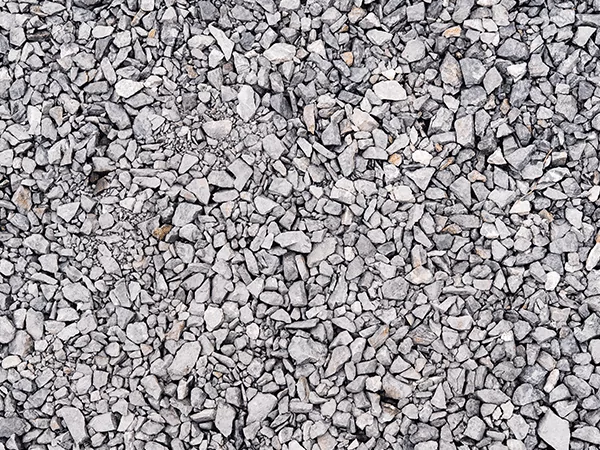
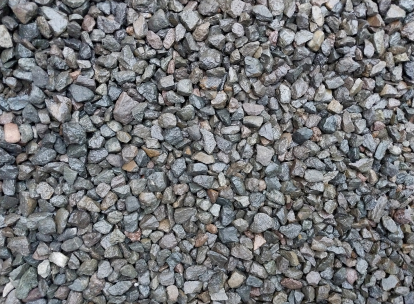
For any driveway with a slope over 5%, the best gravel is angular crushed stone with fines mixed in. The top pick is crusher run (also sold as quarry process, road base, or 3/4″ minus), used either as the surface over a deeper base or as the entire compacted body.
Behind it: #57 crushed stone for the middle and #3 crushed stone for the base. Every stone in these has angular edges that bite into each other when compacted. That interlock is the only thing holding a driveway together when gravity keeps pulling it downhill.
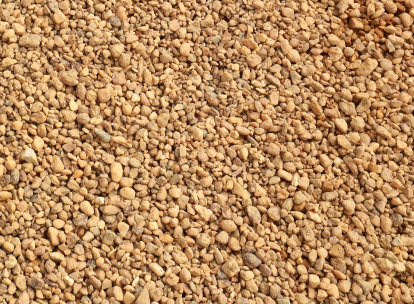
Rounded gravels (pea gravel, river rock, marble chips) should never go on a steep slope. Round stones slide over each other like ball bearings. On a slope, that means the driveway migrates to the bottom of the hill, and your tires spin instead of grip.
What Counts as a “Steep” Driveway?
Slope is measured as a percentage. A 10% slope means the driveway rises 10 feet over every 100 feet.
| Slope | Category | What it changes |
| Under 5% | Gentle | Almost any gravel works |
| 5% to 10% | Sloped | Angular crushed stone required |
| 10% to 20% | Steep | Deeper base, gravel grid recommended, drainage critical |
| 20%+ | Very steep | Past the practical limit for gravel, consider paving |
Most US municipalities cap residential driveways between 10% and 18%. Above 25%, you’re past the legal limit nearly everywhere.
Quick way to measure: hold a 4-foot level horizontally with one end on the high point, measure the vertical drop to the ground at the low end in inches, divide by 48, multiply by 100. That’s your slope percentage.

The Best Gravel Types for a Sloped Driveway
The right driveway uses several materials stacked in layers, not one type from bottom to top.
Crusher Run (Quarry Process / Road Base / 3/4″ Minus)
The workhorse for steep driveways. A mix of angular crushed stone (up to 3/4 inch) and stone dust fines. When compacted, the fines lock everything together into a semi-solid surface that resists shifting even on slopes. Best for the surface layer and often the entire compacted body. Crusher run earns the top pick because the angular edges plus binding fines prevent the dangerous shifting that gets people in trouble on inclines.
#57 Crushed Stone
Clean angular stone (no fines), around 3/4 inch. Drains better than crusher run but doesn’t compact as firmly. On a steep driveway, #57 crushed stone works best as the middle layer between a #3 base and a crusher run surface.
#3 Crushed Stone
The heavy-duty base. Larger angular stones, around 1/2 inch to 2 inches. Creates a sturdy foundation that doesn’t sink into the subsoil under load. For a steep driveway, the #3 base is what stops the whole structure from rutting after the first wet winter.
Crushed Concrete (Budget Pick)
Crushed concrete is recycled and crushed to similar specs as virgin stone. Angular, locks together, performs nearly identically as a base layer at around 30 to 50% lower cost. Use it for the base and middle layers (which get covered anyway). More on the trade-offs in our piece on crushed concrete benefits.
For deeper comparison across sizes and uses, see our gravel types comparison.
Gravel to Avoid on a Steep Driveway
- Pea gravel. Small, round, smooth. Rolls under tires, slides downhill, washes out in the first hard rain. Fine for level walkways. Wrong for any slope.
- River rock. Larger but still rounded. Shifts under vehicle weight even on flat surfaces, faster on slopes.
- Marble chips and decorative stones. Same problem as pea gravel, plus expensive to replace as they wash away.
- Sand or fines without coarse stone. Hard surface when dry, mudslide when wet.
- Anything smaller than 1/2 inch. Doesn’t interlock as a surface (fines mixed into crusher run are the exception).
- Single-size large stones (2 inches or bigger by themselves). No fines to bind them, no smaller stones to fill gaps. Cars rattle and tires spin.
Shorthand: if a stone looks like it came out of a river, keep it off a steep driveway. If it looks like it was just broken with a hammer, it’s a candidate.
How to Layer Gravel on a Steep Driveway
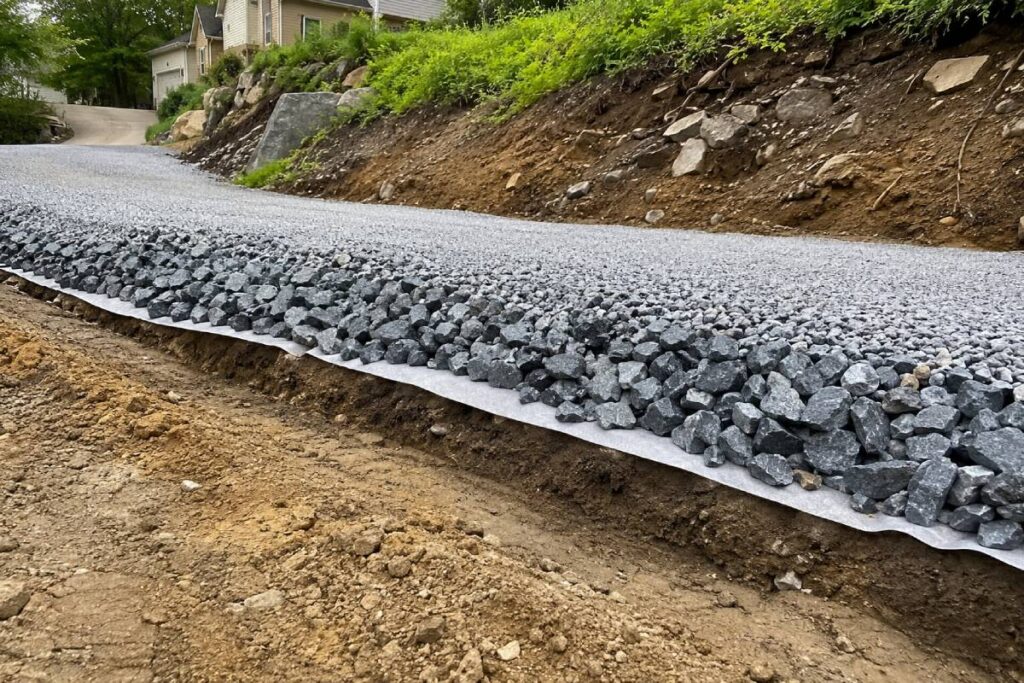
A steep driveway needs three gravel layers over a fabric base. Total depth runs around 8 to 10 inches, versus around 6 inches for a flat driveway.
- Geotextile fabric. Lay it across firm subsoil after excavating 8 to 12 inches deep. Stops the gravel from sinking into the soil and blocks weeds.
- Base layer. 4 to 6 inches of #3 crushed stone or road base. Compact in 2-inch lifts, not all at once. Steeper than 12% calls for 6 inches.
- Middle layer. 3 to 4 inches of #57 crushed stone. Compact again in 2-inch lifts. This is also where a gravel grid gets installed on very steep driveways.
- Surface layer. 2 to 3 inches of crusher run. The fines bind into a semi-solid surface that resists wheel spin and downhill creep. Compact thoroughly.
- Build a crown. The center should sit 3 to 6 inches higher than the edges so water sheds off both sides. A flat-topped steep driveway is a water slide for your gravel.
For the full install walkthrough, see our gravel driveway install guide.
Stabilization Grids: When You Actually Need One
A gravel stabilization grid (also called a geocell or permeable paver) is a plastic honeycomb sheet installed under the surface gravel. It traps stones in individual cells so they can’t shift, roll, or wash away.
Skip the grid if: slope is under 10%, subsoil drains well, traffic is light, and you’re willing to top up every 2 to 3 years anyway.
Install the grid if: slope is between 10% and 20%, you have heavier or frequent traffic, or the driveway has a history of washing out. A grid usually pays for itself in reduced maintenance over five years.
Skip gravel entirely if: slope is over 20%. Pave the steepest section or the whole driveway. A short paved strip on the worst section often costs less than fighting a gravel-on-steep-slope problem for a decade.
Edge restraints (a border of larger stones, timbers, or concrete edging) are worth installing on any steep gravel driveway. They keep surface gravel from migrating sideways into the lawn.
Drainage That Keeps the Gravel in Place
Wrong gravel is the first reason steep driveways fail. Bad drainage is the second. The right gravel washes away just like the wrong gravel if you don’t manage the water.
Three drainage features cover most situations:
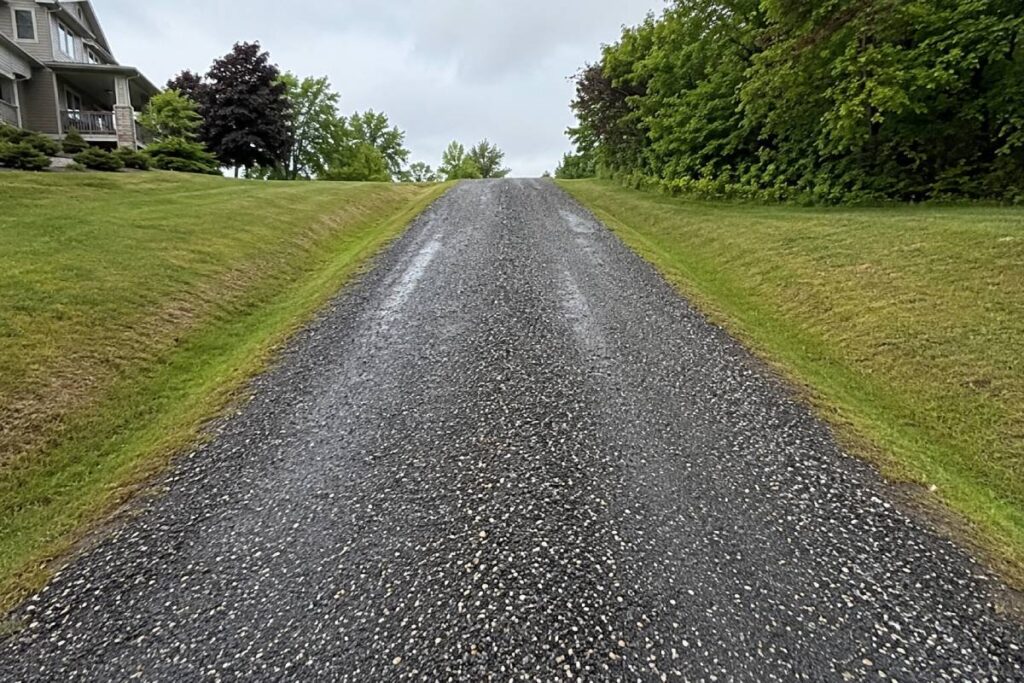
- The crown. 3 to 6 inches higher in the middle than at the edges. Handles light to moderate rain on its own. Non-negotiable on a steep driveway.
- Side swales. Shallow grassy ditches running along both edges, sloped to a safe outlet. Cheap to build, easy to maintain. For most residential steep driveways, a crown plus side swales is enough.
- French drains. A perforated pipe buried in gravel inside a fabric-lined trench, alongside or down the middle of the driveway. Right call when your driveway sits at the bottom of a hill that drains into it, or when side swales get overwhelmed in heavy storms.
For serious uphill runoff, a culvert under the driveway plus a French drain on the high side is the gold standard. Get the water under the gravel before it can push the gravel around.
Maintenance for a Steep Gravel Driveway
- Top-up surface every 2 to 3 years with fresh crusher run to replace what washes out and settles. Flat driveways can usually go 3 to 5 years.
- Rake every few months to fill minor ruts and redistribute gravel piled at the bottom. Prevents the bigger ruts that need full regrading.
- Skip metal plow blades in winter. Each pass scrapes surface gravel off and piles it in the yard. Use a rubber-edged blade or leave a thin layer of snow.
- Keep drainage clear. Walk your swales and French drain outlets in spring and fall. Pull out leaves and sediment. A clogged drain is the most common cause of a sudden washout on a previously fine driveway.
- Fix ruts early. A small rut becomes a deep one in one heavy rainstorm. Fill with crusher run, compact, rake level before the next storm.
Frequently Asked Questions
What size gravel is best for a steep driveway?
Angular crushed stone between 3/8 inch and 2 inches, used in layers. Standard recipe: #3 crushed stone for the base, #57 for the middle, crusher run / 3/4″ minus for the surface. Anything smaller than 1/2 inch on the surface washes away. Anything larger than 2 inches without fines doesn’t interlock properly.
Will pea gravel work on a slight slope?
For slopes under 5%, pea gravel can work for walkways and decorative areas. For any driveway, it’s the wrong call even on slight slopes. It rolls under tires, displaces over time, and gives poor traction even on near-flat ground.
How thick should gravel be on a steep driveway?
Around 8 to 10 inches total compacted depth, in three layers: 4 to 6 inches of base, 3 to 4 inches of middle, 2 to 3 inches of surface. A flat driveway can get away with around 6 inches total.
Do I need a stabilization grid?
Probably yes if your slope is over 10%, especially with regular traffic or a history of washing out. Between 10% and 20%, a grid usually pays for itself in reduced maintenance over five years. Above 20%, consider paving instead.
How steep is too steep for a gravel driveway?
Above 20%, gravel is very difficult to keep in place even with a grid. Above 25%, you’re past the legal max for residential driveways in most US municipalities. Hybrid solutions (paved concrete with grooves for the steepest section, gravel for the rest) are the practical answer when grade is the limiting factor.
How do I stop my gravel from washing down the hill?
In order of priority: switch to angular crushed stone if you’re using anything rounded, build or rebuild a 3 to 6 inch crown, install side swales or a French drain, add a stabilization grid for slopes over 10%, add edge restraints to keep surface gravel from migrating sideways. Wrong gravel and bad drainage are usually both at fault, so fixing only one rarely solves the problem.
How Much Gravel Will You Need?
A steep driveway uses more gravel per square foot than a flat one because the base goes deeper. For a 100-foot by 10-foot steep driveway at 10 inches total depth, that’s around 31 cubic yards, or roughly 43 to 45 tons. That’s a tri-axle dump truck load plus a small follow-up.
For exact tonnage on your dimensions, work through our aggregate calculation guide. For pricing, see how much is a load of gravel and how many tons fit in a dump truck.
Plan to order 10 to 15% extra. You’ll lose some to compaction, spreading, and the natural inefficiency of getting gravel exactly where you want it on a slope.