Fill Dirt Calculator
If you’re a savvy homeowner leveling a yard, prepping for a patio, installing a pool, or grading a driveway, guessing fill dirt volume is the fastest way to waste $300–$1,200.
The Quantity Fill Dirt Calculator right on this page solves that instantly. Just enter your project dimensions and it returns the exact tons and cubic yards you need, already adjusted for real-world 2026 compaction shrinkage, plus the current Gravel Monkey delivered price.
In this complete guide you’ll also discover:
- 2026 density and weight tables
- Coverage charts (tons vs. yards)
- Step-by-step measurement instructions
- Our live delivered pricing tiers
- Exactly how much extra to order
- Fill dirt vs. topsoil explained
- Common mistakes that cost thousands
Let’s get you the right amount, the right material, and professional results the first time.
Fill Dirt Calculator
Enter your project dimensions to estimate how much fill dirt you will need.
Specification Information
Gravel Monkey recommends:
- Orders of 4 tons or under – increase your estimated needed amount by 20%.
- Orders over 4 tons – increase your estimated needed amount by 10%.
How the Quantity Calculator Works
The calculator you see above is built specifically for fill dirt projects. It follows 2026 geotechnical standards (ASTM D698 Proctor test) and uses our real internal density data.
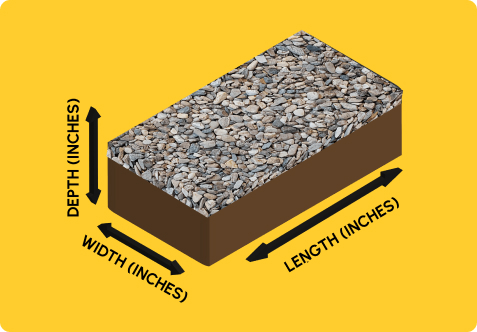
Just fill in these four fields:
- Material – Fill Dirt (already selected)
- Depth in Inches – enter your average depth (e.g., 6)
- Width in Feet – enter the width of the area
- Length in Feet – enter the length of the area
Click CALCULATE and you’ll instantly see:
- Base cubic yards
- Adjusted cubic yards (with built-in 15% compaction buffer)
- Estimated tons (using 2,200 lbs per dry cubic yard)
- Gravel Monkey delivered price range
The tool assumes a simple rectangular area, perfect for most driveways, patios, and level grading jobs. For slopes, irregular shapes, or circles, use the measurement guide in Section 4 below and enter the average dimensions.
What the calculator automatically does for you:
- Converts mixed units (inches depth + feet width/length)
- Applies the 10–20% compaction factor based on 2026 industry standards
- Uses our exact 2,200 lbs/yd³ dry density for accurate ton conversion
2026 Fill Dirt Density & Weight Reference Table
Weight varies by soil type and moisture. Here are the current engineering standards:
| Soil Classification | Dry Weight (lbs/yd³) | Wet Weight (lbs/yd³) | Primary Characteristics |
| Clay Fill Dirt | 2,800 – 3,200 | 3,200 – 3,600 | Highly cohesive, expansive when wet |
| Sandy Fill Dirt | 2,600 – 2,900 | 2,900 – 3,200 | Granular, excellent drainage |
| Loam Fill Dirt | 2,400 – 2,700 | 2,700 – 3,000 | Balanced mix, moderate compaction |
Gravel Monkey insight: One cubic yard of typical dry fill dirt weighs 1.1–1.5 tons. Buying by the ton (the way we deliver) protects you from paying for excess water weight after rain.
Coverage Charts: How Much Area One Ton or One Yard Covers
Per Cubic Yard (volume-based, most accurate)
| Depth | Square Feet Covered by 1 Cubic Yard |
| 1 inch | 324 sq ft |
| 2 inches | 162 sq ft |
| 3 inches | 108 sq ft |
| 4 inches | 81 sq ft |
| 6 inches | 54 sq ft |
| 8 inches | 40 sq ft |
| 12 inches | 27 sq ft |
Per Ton (weight-based, what you actually receive)
| Depth | Square Feet Covered by 1 Ton |
| 1 inch | 240 sq ft |
| 2 inches | 120 sq ft |
| 3 inches | 80 sq ft |
| 4 inches | 60 sq ft |
| 6 inches | 40 sq ft |
| 8 inches | 30 sq ft |
| 12 inches | 20 sq ft |
Step-by-Step: Measure Your Project Accurately
The Quantity Calculator above works best when you give it accurate average dimensions. Guessing or using only the deepest spot is the #1 reason homeowners over-order by 30–50% or run short and need a second expensive delivery.
Follow these proven 2026 field-measurement methods. They take just a few minutes with a tape measure (or laser) and will give you numbers you can plug straight into the calculator for perfect results.
Rectangular or Square Areas (Most Common)
This is the simplest and most frequent shape for driveways, patios, and level grading beds.
Formula:

How to measure:
- Measure length and width in feet.
- Take depth readings at 5–6 spots across the area and use the average (convert inches to feet: 4 in = 0.333 ft).
Example: A 20 ft × 12 ft patio needs an average 4-inch (0.333 ft) base.
Area = 240 sq ft – Volume = (240 × 0.333) ÷ 27 ≈ 3 cubic yards. Plug these numbers into the calculator and it will add the 15% compaction buffer automatically.
Triangular Areas
Common on corner lots, converging property lines, or angled garden beds.
Formula:

Use the same volume formula as above. Measure the two sides that form the right angle or the base and perpendicular height.
Example: A triangular grading area with a 30 ft base and 15 ft height at 6 inches average depth gives roughly 3.3 cubic yards before the buffer.
Circular Areas
Perfect for round fire-pit bases, above-ground pool pads, or tree-ring berms.
Formula:

Example: A 20 ft diameter circular patio (10 ft radius) at 4 inches deep needs about 5.2 cubic yards. Enter the average radius-derived dimensions into the calculator.
Slopes and Uneven Terrain (Wedge Formula)
For hillsides, retaining-wall backfill, or leveling a sloped yard.
Formula:

Measure at the base of the slope (not the slanted surface) and use the maximum vertical height difference.
Example: A 40 ft long × 20 ft wide slope that drops 3 ft at the deepest point needs about 44 cubic yards before the 15% buffer. The calculator will handle the final adjustment.
Irregular or Amorphous Shapes (Radial Method)
Most real yards aren’t perfect rectangles. This 2026 industry-standard technique gives you highly accurate average dimensions.
How to do it:
- Pick a center point roughly in the middle of the area.
- Measure 16 evenly spaced distances (like spokes on a wheel) from the center to the outer edge.
- Average those 16 measurements to get your “effective radius.”
- Plug that average radius into the circle formula above, then enter the resulting average length/width and depth into the calculator.
This method eliminates the empty-corner waste you get when you simply box in an irregular shape.
Avoid the “Deepest Point Fallacy”
Never measure only the lowest spot and apply that depth across the entire area, it causes massive over-ordering. Instead, take multiple depth readings (every 5–10 ft) on a simple grid and calculate the true average depth.
Gravel Monkey pro tip: Accurate average measurements + the calculator’s built-in 15% compaction buffer = no surprises and no second truck. Most homeowners who follow this process save $400–$900 compared with guessing.
Once you have your average length, width, and depth, enter them directly into the Quantity Calculator at the top of the page. It does the rest, including the conversion from inches to feet and the compaction adjustment, so you can order with total confidence.
Should You Order Extra? Compaction & Settling Guide
Loose dirt swells 20–30% during excavation, then shrinks when compacted.
Recommended buffers (2026 standard):
- General grading – 10–15% extra
- Structural / load-bearing – 15–20% extra
The Quantity Calculator already adds a 15% buffer by default. From our 2,000+ deliveries, we see an average 12% real-world shrinkage, so the built-in buffer keeps your job on schedule and avoids expensive second deliveries.
Fill Dirt vs Topsoil: Which One Do You Actually Need?
| Feature | Fill Dirt | Topsoil |
| Organic content | Virtually zero | 2–10% |
| Best for | Structural base, grading | Lawns, gardens, planting |
| Compaction | Excellent (stays stable) | Poor (settles and shifts) |
| Price per yard | $5–$30 | $10–$50 |
Best practice: Use fill dirt for the structural base, then top with 4–6 inches of topsoil for plants.
Common Mistakes & How to Avoid Them
- Using only the deepest point – over-order by 30–50%.
- Forgetting the compaction buffer – run short and pay rush fees.
- Confusing cubic feet with cubic yards – 27× error.
- Buying by the yard when material is wet – paying for water.
The Quantity Calculator and the measurement guide above eliminate every one of these.
2026 Cost & Market Trends Update
The Producer Price Index for construction materials rose 12.6% annualized in early 2026. Fuel surcharges and supply pressure are real, but our nationwide routing and volume tiers still deliver the lowest landed cost for most homeowners. Locking a quote now often beats waiting for later-season increases.
FAQ
How much does 10 tons of fill dirt cost delivered in 2026?
With Gravel Monkey, 10 tons (8 cubic yards) is $521 delivered, about $52 per ton.
Does the calculator include compaction?
Yes, it automatically adds a 15% buffer based on 2026 geotechnical standards.
Can I use the calculator for sloped or irregular yards?
Yes, measure the average width, length, and depth, then enter those numbers.
Should I buy fill dirt by the ton or by the yard?
By the ton, it protects you from paying for water weight.
How much extra should I order?
The calculator’s built-in buffer is perfect for most jobs; adjust the slider if you want more or less.
Can I use topsoil as fill dirt?
No, it decomposes and causes settling and structural failure.
What’s the minimum order?
Most deliveries start at 3 tons.
Do you deliver fill dirt nationwide?
Yes, fast 2-day delivery to all 50 states.
Ready for Professional Results at a Fraction of the Cost?
The Quantity Calculator above plus the data in this guide gives you everything you need to order exactly the right amount of fill dirt in 2026. Accurate math + the right material = a stable, long-lasting project and real money saved.