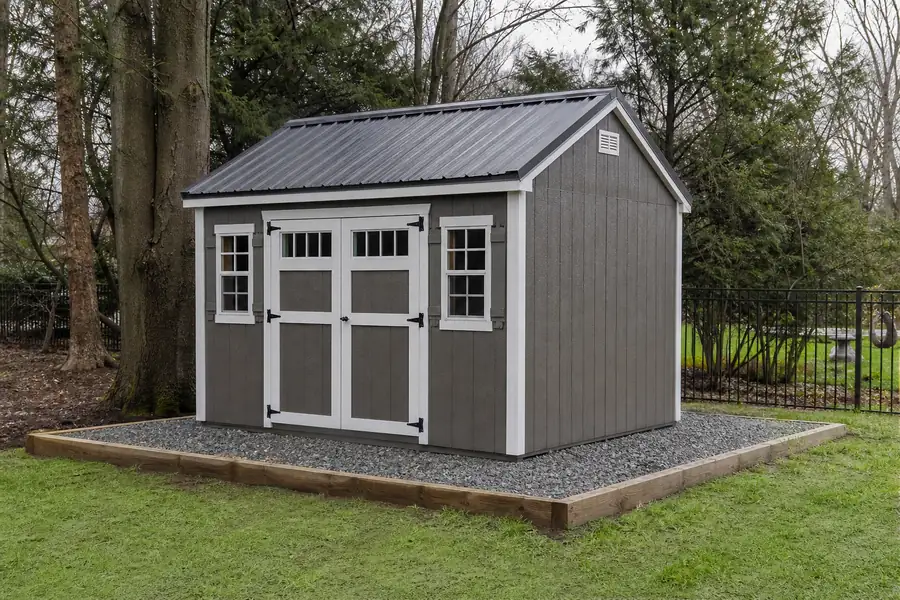
How to Build a Gravel Shed Base That Will Not Settle
A shed base fails one of two ways: it settles unevenly until the door stops latching, or it holds moisture against the floor and rots the joists from below. Both problems trace back to the same three decisions: how big you build the pad, how deep you compact the base material, and what holds the edges in place. Get those right and a gravel shed base will carry a loaded shed level for decades without a redo.
Key Takeaways
- Build the pad 12 inches larger than the shed footprint on every side to keep the frame off ground moisture and give runoff somewhere to go.
- Use 4 to 6 inches of compacted crusher run for sheds up to about 10×12; step up to 6 to 8 inches for anything bigger.
- Compact in shallow lifts with a plate compactor, not by driving over the stone or waiting for rain to settle it.
- Edge the pad with pressure-treated timber or steel landscape edging so the stone stays put under the shed frame.
- Check level across the whole pad; more than 1/4 inch of pitch over 10 feet is enough to jam a door.
- Gravel drains better and costs less than a poured slab, though it needs an occasional top-up over the years.
Sizing a Gravel Shed Base
A gravel shed base should extend 12 inches past the shed’s footprint on all four sides. That overhang keeps roof and wall runoff from sheeting straight onto the shed floor, and it gives you room to actually reach the corners with a compactor instead of hand-tamping blind.
An 8×8 shed needs roughly a 10×10 pad. A 12×20 shed needs closer to 14×22. Skimping on the overhang is one of the more common shortcuts, and it’s the reason so many sheds show splashback rot along the bottom board within a few years.
How Deep Should a Gravel Shed Base Be

A gravel shed base needs 4 to 6 inches of compacted crusher run for sheds up to about 10 by 12 feet, and 6 to 8 inches for anything larger. Bigger footprints put more point load on the skids or frame rails, and a thicker base spreads that load into the subgrade before it can punch through and settle.
Crusher run works well here because it’s a mix of crushed stone and fine particles that lock together tightly once tamped. Some builders use road base instead, since it carries a similar blend of stone and fines and compacts to a comparably hard surface. Either material should go down in lifts of about 2 inches, wetted lightly, and run over with a plate compactor before the next lift goes on.
Pad size and tonnage by shed size:
| Shed size | Pad size (with overhang) | Base depth | Crusher run needed |
|---|---|---|---|
| 8×8 | 10×10 | 4-6 in | ~2 tons |
| 8×12 | 10×14 | 4-6 in | ~3 tons |
| 10×12 | 12×14 | 6-8 in | ~5 tons |
| 12×16 | 14×18 | 6-8 in | ~7.5 tons |
| 12×20 | 14×22 | 6-8 in | ~9.5 tons |
These figures assume compacted crusher run at a typical density, so treat them as a starting point rather than a final order. Run your own pad dimensions through the road base calculator to get a tonnage figure matched to your exact depth and footprint before you order.
Edging and Leveling a Gravel Shed Base
Edging keeps a gravel shed base from creeping outward under the weight of the shed and foot traffic. Pressure-treated 2×6 or 2×8 lumber staked every 2 to 3 feet works for most backyard sheds; steel landscape edging holds a straighter line and lasts longer where ground movement is a concern. Pin the corners so the frame can’t rack out of square as the stone settles into it.
Level matters more than most people expect. Set stakes at each corner with a string line, then check the pad with a 4-foot level or a laser across its full length in both directions. A tolerance of 1/4 inch over any 10-foot run is the practical limit: much more than that and the shed’s door frame will bind on one side within the first year. A slight crown of about 1 percent, roughly a quarter inch of fall per 2 feet, sheds water off the pad without throwing off that tolerance, as long as the slope is even and not lopsided in one corner.
A layer of geotextile fabric under the crusher run, between the subgrade and the stone, stops the base from working its way down into soft soil over time. It’s a cheap step that pays off most in clay soils or anywhere drainage is already marginal, a topic covered in more depth in the guide to best base for a gravel driveway, which walks through how base layers behave under sustained load.
Gravel Shed Base vs Concrete Slab vs Plastic Grid

A gravel shed base costs less and drains better than a poured concrete slab, while a plastic grid system splits the difference on effort but still needs the same compacted stone underneath it.
| Base type | Cost per sq ft (installed) | Effort | Drainage | Lifespan |
|---|---|---|---|---|
| Gravel base | $3-$6 | Moderate DIY | Excellent | 15-20+ yrs with top-ups |
| Concrete slab | $6-$12 | Usually contractor | Poor, needs slope/drain | 25+ yrs, can crack |
| Plastic grid | $4-$8 | Easy DIY | Excellent | 20+ yrs |
Concrete gives the most rigid, permanently level surface, but it costs more, traps water against a wood floor if it isn’t sloped correctly, and can crack in freeze-thaw regions. A plastic grid system fills with the same crushed stone and locks it in place cell by cell, which is useful on soft or uneven ground, but it still needs a compacted crusher run layer beneath it to do any good. For most storage sheds, a well-built gravel pad delivers the drainage and stability the shed actually needs without the cost or curing time of a slab.
Common Mistakes When Building a Gravel Shed Base
- Skipping excavation: laying gravel straight over sod leaves organic material underneath that decomposes and settles unevenly within a season.
- Compacting dry stone: crusher run needs a bit of moisture to lock together; compacting it bone dry leaves voids that collapse later under load.
- Undersized pad: skipping the 12-inch overhang means splashback rots the bottom board and there’s no room to compact the edges properly.
- No edging: without a border, stone migrates outward and the depth under the shed frame drops below spec exactly where it matters most.
FAQs
How big should a gravel base be for a shed?
Build the pad 12 inches larger than the shed’s footprint on every side. An 8×10 shed needs roughly a 10×12 pad, which gives room for runoff to clear the structure and lets a compactor reach every edge.
How deep does gravel need to be under a shed?
Most sheds up to about 10 by 12 feet need 4 to 6 inches of compacted crusher run. Larger sheds, from 10×12 up through 12×20 and beyond, should get 6 to 8 inches to spread the added weight into the subgrade.
Can I set a shed directly on gravel without a frame?
No. Gravel forms the compacted pad, not the finished floor. Most sheds still need a treated wood skid frame or a metal base kit resting on top of the leveled gravel so the floor stays off the stone and drains properly.
Will a gravel shed base settle over time?
A small amount of settling is normal in the first season as the stone continues to lock together under the shed’s weight. Beyond that, a properly compacted base at the right depth should hold level for many years, especially if it was checked and re-leveled once after the first winter.
Is gravel or concrete better for a shed base?
Gravel drains better, costs less, and is easier for most homeowners to build themselves, while concrete offers a more rigid surface but costs more and drains poorly if it isn’t sloped correctly. For a typical storage shed, a properly built gravel base performs just as well without the added cost.