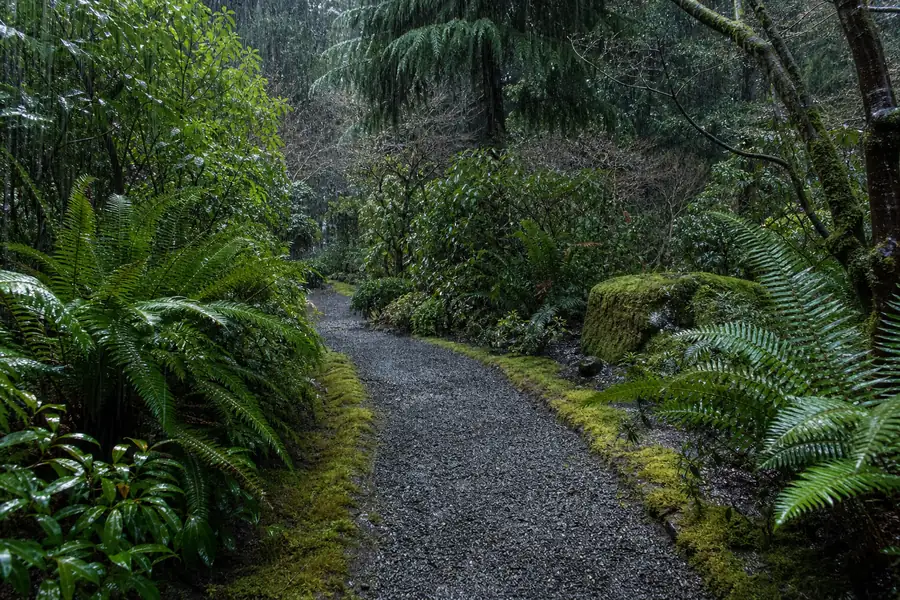
Gravel in Seattle and the Pacific Northwest: Drainage for 40 Inches of Rain
Seattle doesn’t get hit with intense downpours very often. It gets soaked for months at a time. That slow, steady soak is exactly what makes drainage the first question in any gravel Seattle project, whether it’s a driveway, a French drain, or a path under the cedars.
The region’s climate and its glacial soils change what counts as the right stone here compared to almost anywhere else in the country. Get it wrong and water backs up, moss takes over, and a drainage fix turns into a repeat expense.
- Seattle averages close to 40 inches of rain a year spread across 150 or more wet days, so saturation matters more than storm intensity.
- Glacial till under much of the Puget Sound lowlands drains poorly, so gravel systems have to do the work the soil can’t.
- French drains here need washed, open-graded stone like drain rock, never a “minus” product that carries fines.
- Quarter minus and five-eighths minus are Pacific Northwest names for graded base material, not drainage stone.
- Decorative gravel in shaded yards grows moss and algae fast, so airflow and stone shape matter as much as size.
- Local stormwater rules increasingly favor on-site infiltration, which is where rain gardens and dry wells come in.
Why Gravel in Seattle Has to Handle 40 Inches of Rain a Year
Seattle averages close to 40 inches of rain annually, but the real challenge is duration, not volume. Rain falls on 150 to 160 days a year, often as light, steady drizzle that soaks the ground for weeks without a real dry stretch in between.
Portland, Oregon sees a similar pattern a few hours south, and gravel systems there face the same problem: soil that never fully dries out between storms. That constant moisture load is why a driveway base or drainage trench built for a drier climate falls apart in this region.
Standard crushed stone with fines packs down and holds water instead of moving it through. In a climate that rarely gives the ground a chance to dry, that trapped water doesn’t just sit there, it softens bases and floats fines up to the surface over a wet winter.
Glacial Till Soils Around Seattle and Why Percolation Fails
Glacial till is the dense, compacted mix of clay, sand, and rock left behind by the ice sheets that once covered the Puget Sound lowlands, and it barely lets water through. Percolation rates in till can run several times slower than in a sandy loam, so water that would soak away in an hour somewhere else can sit on the surface for days here.
That poor percolation is why a gravel base alone rarely solves a drainage problem in Seattle. The stone has to store water and slowly release it, or move it sideways to an outlet, because the soil underneath isn’t going to absorb much on its own.
Yards across the Seattle area see this constantly: ground that looks flat and well-graded still puddles for a day or two after a storm because the till a few inches down won’t let water past.
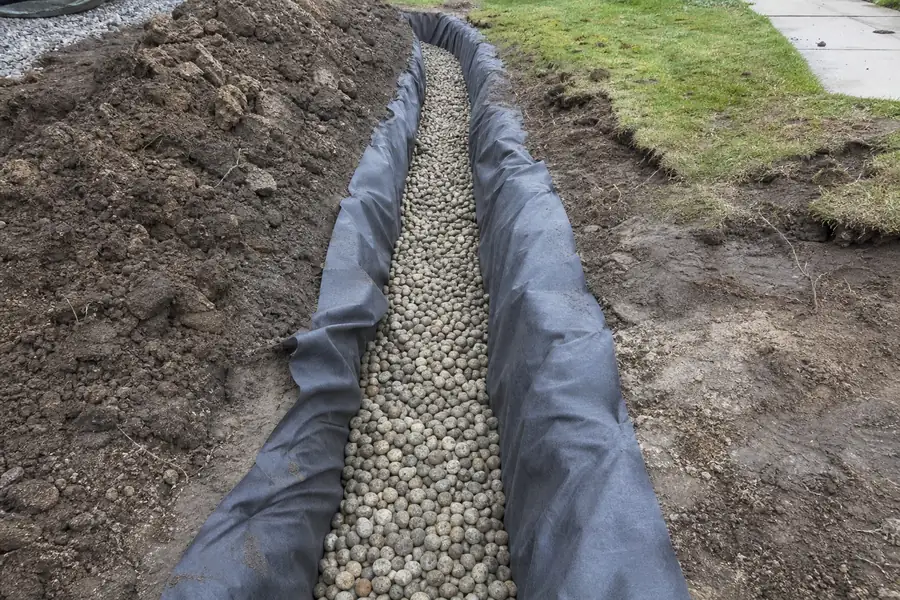
French Drains and Drain Rock in Seattle: The Quarter-Minus/Five-Eighths-Minus Naming Quirk
Why Washed Open-Graded Stone Is Non-Negotiable in a French Drain
A French drain is a gravel-filled trench with a perforated pipe at the bottom that carries groundwater away from a foundation or low spot. In Seattle’s wet, till-heavy soil, the gravel around that pipe has to be washed and open-graded, meaning a single stone size with no sand or fines mixed in, so water moves through the void space instead of getting trapped.
Crushed stone or base material with fines compacts under pressure and clogs a French drain fast, especially once the surrounding till stays saturated for weeks at a stretch. Drain rock is the product built for this job, and our best gravel for drainage guide walks through gradations for different drainage projects. For French drains specifically, the best gravel for a French drain is almost always washed, open-graded 3/4 inch to 1.5 inch stone.
Quarter Minus and Five-Eighths Minus, Explained
Quarter minus and five-eighths minus are Pacific Northwest names for graded aggregate, not national standard terms, and they describe the largest particle size in the mix rather than one uniform stone size. Quarter minus tops out around 1/4 inch and includes fines and dust, which is exactly why it compacts so well as a path or driveway base, similar to road base sold under other regional names.
Five-eighths minus works the same way at a larger top size, up to 5/8 inch, still with fines included. Neither belongs in a drainage trench. If a supplier offers “minus” material for a French drain, ask for washed drain rock instead, because the fines that make minus material compact well are the same fines that clog a drain.
Sizing a Rain Garden and Downspout Dry Well for Seattle Rainfall
A rain garden is a shallow, planted depression that collects roof and yard runoff and lets it soak into the ground instead of running to the street. Sized for Seattle rainfall, it typically covers 20 to 30 percent of the draining roof or hardscape area, with 18 to 24 inches of amended soil over a 6 to 8 inch layer of open-graded gravel underneath.
A downspout dry well is a gravel-filled pit that captures water from a single downspout and lets it infiltrate underground. Most residential dry wells run about 3 feet across and 3 to 4 feet deep, filled with clean 1.5 to 2 inch drain rock and wrapped in geotextile fabric to keep till and silt out of the void space.
| Feature | Rain Garden | Downspout Dry Well |
|---|---|---|
| Typical size | 20-30% of drainage area | 3 ft diameter, 3-4 ft deep |
| Gravel layer | 6-8 in open-graded stone | Full pit, clean drain rock |
| Gravel size | 3/4-1.5 in washed | 1.5-2 in washed |
| Best for | Roof and yard runoff | Single downspout |
| Fabric needed | Optional separator | Yes, wrap the pit |
Both designs assume the region’s typical design storm, roughly 1 inch of rain in 24 hours, which is what most Seattle-area stormwater guidance is built around. Undersize either one and the first hard rain of the fall finds the overflow route you didn’t plan for.
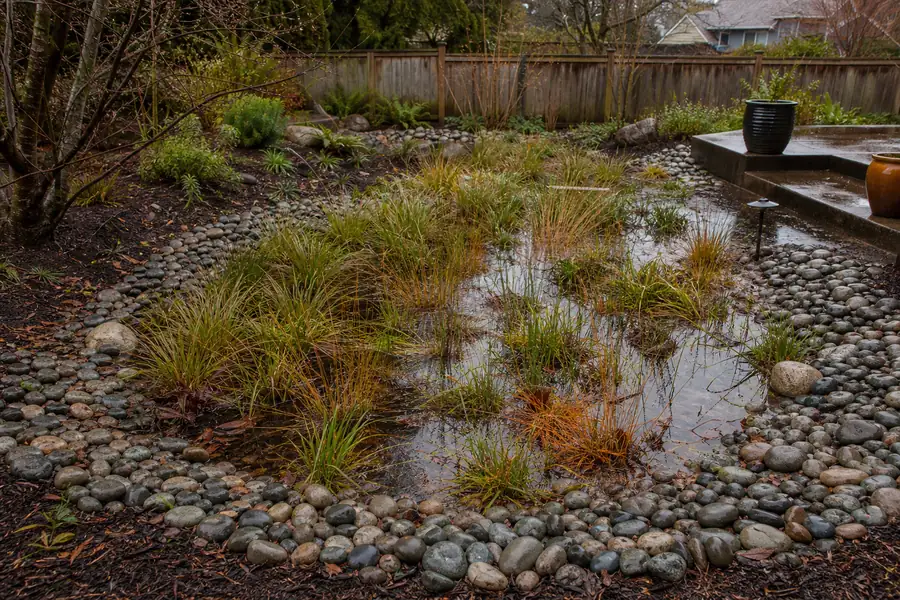
Moss, Algae, and Seattle Stormwater Code Considerations for Gravel
Decorative gravel in shaded, damp corners of a Pacific Northwest yard grows moss and algae faster than in most parts of the country, because shade from tall conifers keeps the stone wet for days after every storm. Rounded pea gravel and river rock hold moisture in the gaps between stones longer than angular crushed stone, giving moss more time to take hold.
Raking gravel paths a few times a year, clearing overhanging branches, and choosing angular, fast-draining stone over rounded decorative gravel in shaded beds all cut down on the green film that makes gravel slick underfoot.
Seattle and surrounding jurisdictions have leaned harder each year toward requiring new construction and major additions to manage stormwater on site instead of piping it straight to the street. That generally means some combination of permeable surfacing, rain gardens, or infiltration systems sized to the property’s impervious area. Requirements vary by lot and jurisdiction, so it’s worth checking with the local building department before finalizing a plan, but the direction is the same everywhere in the region: keep the water on site and let gravel and soil do the filtering.
FAQs
Does gravel actually work for drainage in Seattle’s clay and till soils?
Yes, but only if it’s washed, open-graded stone with no fines. Gravel with fines compacts and holds water the same way till soil does, while open-graded drain rock leaves void space for water to keep moving even when the surrounding soil is nearly saturated.
What size gravel is best for a French drain in Seattle?
Most French drains in the Seattle area use washed 3/4 inch to 1.5 inch drain rock around the perforated pipe. Larger, open-graded stone resists clogging better than smaller gravel in soils that stay wet most of the year.
Is quarter minus the same as drain rock?
No. Quarter minus is a compacted base material that includes fines and dust, which works well for paths and driveways but is wrong for drainage. Drain rock is washed and open-graded with no fines, so water passes through instead of pooling.
Why does my gravel path grow moss so fast in Seattle?
Shade from trees combined with near-constant moisture keeps gravel wet long enough for moss and algae to establish, especially with rounded stone that traps water between pieces. Choosing angular crushed stone and raking the path a few times a year slows regrowth considerably.
Do I need a permit for a rain garden or dry well in Seattle?
Many small residential rain gardens and dry wells don’t require a permit, but larger systems tied to new construction or major additions often do under local stormwater rules. Check with your city or county building department before digging, since requirements vary by lot size and impervious area.