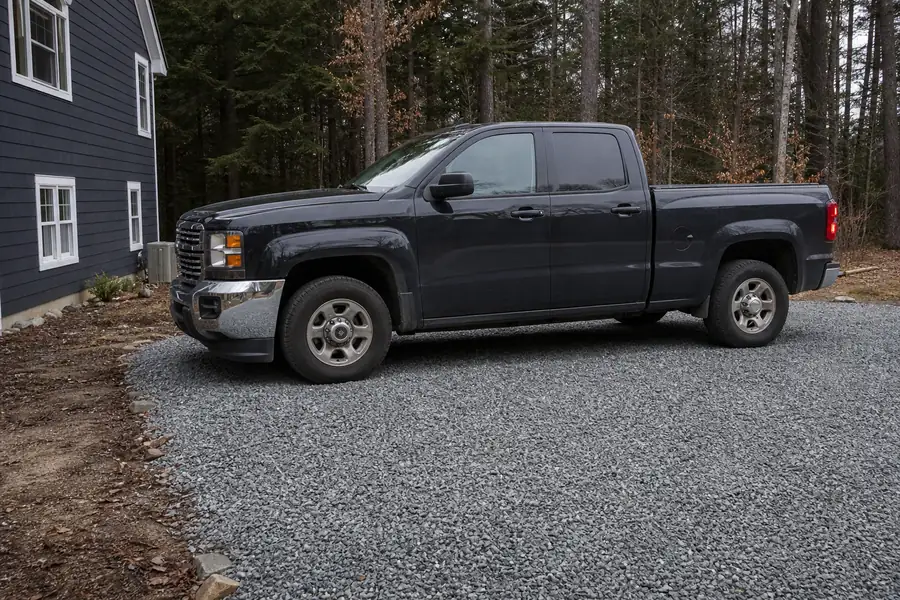
How to Build a Gravel Parking Pad for Cars, Trucks and Trailers
A gravel parking pad built like a driveway will rut, pothole, and sink within a season. The reason is simple: a parked vehicle sits in one spot and pushes all its weight straight down, while a driveway’s load keeps rolling and spreading that weight across the surface. Get the sizing and base right from the start and a gravel parking pad will hold a truck, a car, or a loaded trailer for years without turning into a mud pit.
This guide covers how big to build the pad, why it needs a deeper base than a driveway, and how to layer, edge, and grade it so water drains instead of pooling under your tires.
Key Takeaways
- Size the pad to the vehicle: 10 by 20 feet for a car, 12 by 24 feet for a truck, 12 by 40 feet for a truck and trailer combo.
- Parking pads need about 8 inches of base, roughly double a typical driveway, because parked vehicles apply static point loads instead of rolling loads.
- Build in two compacted lifts: 4 inches of 2-3 inch base rock, then 4 inches of crusher run on top.
- Grade a 1 to 2 percent cross fall so water sheets off instead of soaking into the base.
- Containment edging and gravel grid stabilizers keep the surface from spreading or sinking on soft ground.
- Check local setback and permit rules before you order material, since many municipalities regulate parking pads differently than driveways.
How Big Should a Gravel Parking Pad Be?
A gravel parking pad for a single car should measure at least 10 by 20 feet, giving enough room to pull in straight and open doors without stepping into landscaping. A pickup or full-size truck needs 12 by 24 feet to clear mirrors and tailgates. A truck paired with a trailer needs 12 by 40 feet so the whole rig sits on stable base rather than hanging a tire off the gravel’s edge.
| Vehicle type | Recommended pad size | Area (sq ft) |
|---|---|---|
| Single car | 10 ft x 20 ft | 200 |
| Truck or full-size pickup | 12 ft x 24 ft | 288 |
| Truck plus trailer | 12 ft x 40 ft | 480 |
These are minimums, not luxury measurements. Add a couple of feet on each side if you want room to walk around the vehicle or load gear from a trailer without stepping off the gravel.
Why Gravel Parking Pads Need a Deeper Base Than a Driveway
A gravel parking pad carries static point loading, meaning the full weight of a parked vehicle rests on the same four contact patches for hours or days at a time. A driveway carries rolling load: tires move across the surface, spreading that weight over a wider path and never letting it concentrate in one place long enough to punch through a thin base.
That difference is why a driveway can often get by with 4 to 6 inches of base, while a parking pad needs closer to 8 inches total. Skimp on depth and the stone under each tire slowly works down into the soil beneath it, leaving four shallow ruts right where the vehicle sits.
Clay soils make this worse. Clay holds water and softens under sustained weight, so a pad built over clay without enough base depth will sink faster than one built over sandy or well-draining ground.

Building a Gravel Parking Pad: Base Layers and Compaction
A load-bearing gravel parking pad is built in two compacted lifts, not one thick pile of stone dumped and leveled by hand.
Lift one: base rock
Start with 4 inches of 2-3 inch crushed stone over the excavated subgrade. The large, angular pieces lock together and create void space that drains water away from the surface instead of trapping it against the soil.
Lift two: crusher run
Top that with 4 inches of crusher run, a mix of crushed stone and stone dust that packs down into a dense, nearly solid surface once compacted. Run a plate compactor over each lift separately before adding the next; compacting 8 inches at once leaves the bottom layer loose and the whole pad settles unevenly later.
Grade the finished surface with a 1 to 2 percent cross fall, about 1 to 2 inches of drop for every 10 feet of width, so rain sheets off to one side instead of pooling where tires sit. Materials for both lifts are available through Gravel Monkey’s base materials lineup, and the same base-building principles used for driveways apply here, just at a greater depth.
Containment Edging and Gravel Grid Stabilizers for Soft Ground
Containment edging keeps a gravel parking pad from spreading at the perimeter as vehicles roll on and off it. Steel, aluminum, or heavy plastic edging set along the pad’s border holds the stone in place under repeated turning and braking, which is harder on edges than straight driveway travel.
On soft or sandy ground, gravel grid stabilizers add another layer of insurance. These are interlocking plastic cells laid over the compacted base and filled with gravel; they spread point loads sideways across the grid instead of letting a single tire punch straight down into weak soil. They’re worth the extra cost on any pad built over fill dirt, sand, or ground that stays soft after rain.

Permits and Setback Rules for a Gravel Parking Pad
Many cities treat a gravel parking pad as an impervious surface improvement, which can trigger permit, setback, or drainage requirements separate from those covering driveways. Rules vary widely by municipality, and some jurisdictions restrict how close a pad can sit to a property line or require it to drain onto your own lot rather than a neighbor’s.
Check with your local building department before ordering material. In regions with heavy clay soil or seasonal flooding, inspectors sometimes require a drainage plan showing where the cross fall directs runoff.
Gravel Parking Pad Tonnage and Cost vs Concrete
Tonnage scales with pad size and the full 8 inches of combined base depth. Use Gravel Monkey’s gravel calculator to fine-tune the figures for your exact dimensions.
| Pad size | Base rock (tons) | Crusher run (tons) | Total tons |
|---|---|---|---|
| 10 x 20 ft (car) | ~3.5 | ~3.5 | ~7 |
| 12 x 24 ft (truck) | ~5 | ~5 | ~10 |
| 12 x 40 ft (truck + trailer) | ~8.5 | ~8.5 | ~17 |
A gravel parking pad typically runs $1 to $3 per square foot installed, covering excavation, two lifts of base, and edging. A concrete pad of the same size usually falls between $6 and $12 per square foot once forming, pouring, and finishing are included. Gravel costs less upfront and drains better on its own, though it needs occasional topping up where concrete does not.
FAQs
How deep should a gravel parking pad be?
Plan for about 8 inches of compacted base total: 4 inches of 2-3 inch crushed stone topped with 4 inches of crusher run. That depth handles the static point loads of a parked vehicle without rutting the way a thinner driveway-style base would.
Can I build a gravel parking pad on clay soil?
Yes, but clay soil holds moisture and softens under sustained weight, so it needs the full 8 inch base and good cross fall drainage to perform well. Skipping depth or slope on clay is the most common reason parking pads sink within the first year.
Do I need edging around a gravel parking pad?
Containment edging is strongly recommended because turning and braking push gravel outward at a pad’s edges more aggressively than straight-line driveway travel does. Steel or heavy plastic edging holds the border in place and cuts down on how often you need to top up stone.
How much gravel do I need for a parking pad?
A single-car pad (10 by 20 feet) takes roughly 7 tons split between base rock and crusher run, a truck pad (12 by 24 feet) takes about 10 tons, and a truck-plus-trailer pad (12 by 40 feet) takes around 17 tons. Exact amounts depend on your final depth and compaction, so run your dimensions through a gravel calculator before ordering.
Is a gravel parking pad cheaper than concrete?
Yes, a gravel parking pad typically costs $1 to $3 per square foot installed versus $6 to $12 per square foot for concrete. Gravel also drains on its own, though it will need occasional regrading and top-up stone that a concrete pad does not require.